

Policy and insights report
The future career paths of accountancy professionals will be less linear and more flexible, finds our latest report which explores eight significant drivers changing the world of work.
At a glance
Identify skillsets you need to nurture for a successful flexible career.
Get insights on how key drivers of change could affect your career at any stage.
Explore what our survey results tell us about future careers paths in accountancy.
Key findings
- Future career paths are less linear, more flexible and personalised in nature, shorter-term in focus, and more adaptive to circumstance and opportunity.
- In a rapidly changing world of work – where the core principles of how and why we work evolves at pace – continually developing the right skills is essential to navigating a flexible workplace.
- While career paths may be less certain than in the past – the opportunities to grow and thrive have never been greater for those prepared to embrace change.
Career paths reimagined
The world of work is changing. Hear from ACCA members across the globe as they share how diverse career paths, hybrid roles, and emerging technologies are redefining the profession. From embracing AI to building human‑centred skills like judgement, integrity and insight, ACCA accountants are equipped to thrive in a world where lifelong learning is the new normal.
Skills for future careers
By 2035 how, when and where finance professionals work, as well as the nature of the work itself, will look very different. Our research showed that 51% of global respondents believed that flexible career paths will replace linear paths within the next decade. A further third (35%) expected the two approaches to coexist equally and only 27% feel that they are adequately prepared.
Preparing for this flexible career structure is at the core of suggested actions in this report. Around 2,600 ACCA members and future members together with 145 employers took part in the global research which identified the relevant skill sets that finance professionals should nurture for future career success as explored in the list below.

Technical
These skills are at the core of the accountancy and finance professional. However, they are likely to deepen into domains as roles become more focused on enhancing data driven insights. Individuals will shift areas of expertise several times in their careers while maintaining an overall focus.

Data
Data is the lifeblood of organisations as AI and insights increasingly dominate the business environment. Knowledge of data provenance, cleaning, governance, and integrity are essential skills; as are data preparation and programming skills such as Python, R and SQL. Human-driven quality assurance and guardianship.

Insight
Data can only be part of the story, having capabilities to derive insight from the data are essential. These include analytical techniques, such as critical thinking and problem-solving, data visualisation and interpretation, and guardianship.

Strategy
Operating environments will become more challenging as automation and sustainable-business models are increasingly embedded. Strategic planning and economic modelling in a low growth environment where margins are slim and opportunities need to be grasped quickly. This includes broader strategic focus, such as partnerships and collaboration.

Ethics
In a world where trust in information is increasingly questioned, standing out as a credible source of ‘truth’ in organisations and the wider business environment is essential. Applying an ethical lens to insight generation is paramount. Ethical dilemmas will become more complex. This feeds into governance, leadership and strategy.

Risk
The complexity of the business environment and funding challenges will increase risk dilemmas. Assessing implications of regulatory environment, economic and geopolitical pressures.

Technology
The technological evolution gathers pace with new opportunities. Possessing skill sets that appreciate emerging applications and their applicability to the business environment and operating models is essential.
This is not to say that they need to be technologists, but rather consciously competent in its application and aware of the inter-connectivity and role of specialists in this area.

Storytelling
An insight itself is not sufficient. How the human communicates these, and provides analysis and interpretation in an effective and concise manner, are the differentiators – viewing through a strategic lens and interpreting data-driven insight.

Curiosity
In a changing world, simply taking an answer or analysis at face value is not sufficient. The ‘why’ question is a core skill. Being curious about the world is fundamental. Curiosity about skills, learning and development, as well as the wider implications of analysis undertaken. This feeds into both storytelling and strategy.

Business
The traditional business environment is evolving. New funding models will develop and complexity in the capital markets – in part caused by geopolitical shifts – will increase. Forward-looking business acumen navigates this complex world. Internal and external focus is needed.
Drivers of change
Survey respondents ranked technology as the most significant of eight drivers of change reshaping future career paths and workplaces, with changes in personal expectations of work coming in second place, and other drivers shown in this illustration.
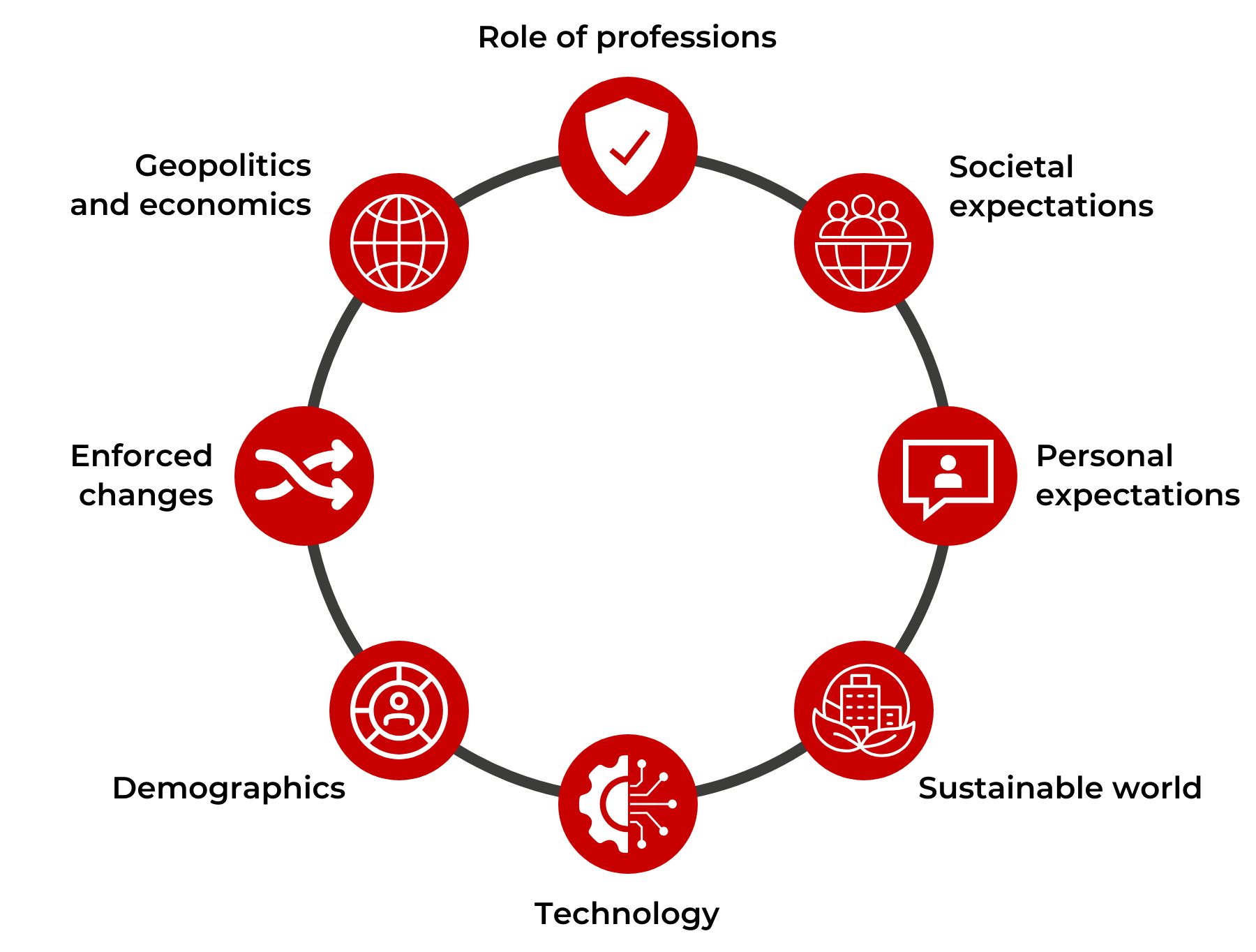 Circular diagram listing the eight drivers of change reshaping future career paths of accountants and finance professionals. They are the role of professions, societal expectations, personal expectations, the sustainable world, technology, demographics, enforced changes and geopolitics and economics.
Flexible career factors
Career paths are changing – they are no longer strictly linear but increasingly flexible. Shorter role tenures are accompanied by deeper technical expertise and strong interpersonal skills that facilitate flexibility. The accountancy and finance profession has been at the forefront of this transition – the flexibility that the qualification offers opens a range of opportunities.
Other factors explaining why flexible career trajectories are likely to dominate include:
- An evolution of organisational structures – removing traditional middle-level roles and replacing them with more specialist roles. Entry points are evolving and are being redefined by new ways of working and a demand for specific skills and experience. Employers should seek to review their traditional career models.
- Advances in technology - reducing or transforming entry-level roles and changing the nature of the roles themselves.
- Demographic changes – lengthening the working life.
- Flattening economic performance – making sideways moves more important for career and financial progression.
- Disenchantment with the impact on work-life blend and the immediate financial and lifestyle needs driving chosen career paths – particularly during economic and geopolitical uncertainty
Features of a future successful career
The key features of a successful future career are summarised below:

Hyper-personalised careers
Flexible not linear career paths.
Interpersonal skills define the ability to move roles, but deeper technical skills define the role.
Personal motivation key to a successful career.

Short-term goals not long-term ambitions
Focus on next career step as careers and roles will evolve rapidly.
Organisational structures will favour the flexible specialist in a generalist world.
Consider career breaks and micro-retirements as tools to extend the working life.

Flexibility and fluidity
Be prepared for changes in roles as technological evolutions continue.
Consider where and how you work, including migration (both physical and technological).
Coach others to accelerate experiences and insights.

Maintaining skill package; skills that AI cannot bring
Insight generation a core skill for the future.
Ensure that you possess skills that augment the technology.
Be consciously competent in the use of technology within the context of your role.

Curiosity
Drive insights through a curious mindset.
Challenge business models to maximise the value from data and technology.
Never stand still in your role – seek new challenges and motivations.

Agility and absorbing new ideas
Continuously learn in a rapidly changing world.
Be prepared to lead and not manage.
Think beyond the traditional accountancy and finance roles.
Policy and insights report
Career paths reimagined. The changing world of work.
"To be successful, finance professionals must be willing to let go of outdated expectations and embrace a future which will see the rise of hyper-personalised careers featuring more flexibility but less predictability. Taking greater ownership of your career and learning is key – continually developing the right skills is essential to navigating a flexible workplace."
Helen Brand, Chief Executive, ACCA
"Curiosity and agility will be key features of a successful career as careers will be flexible and dynamic. The career paths of the future hold significant promise for those ready to seize the opportunity. Employers need to adapt to and anticipate changes now to maximise talent, match skills demand and provide a sustainable pipeline of talent for a redefined profession."
Clive Webb, Head of Business Management, ACCA
