

ACCA welcomes the opportunity to provide feedback on this consultation “Tax Support for Entrepreneurs: Call for Evidence” building on the governments Invest 2035: the UK's modern industrial strategy and the immediate term actions specified in the Entrepreneurship Prospectus. We welcome this review of the impact, accessibility and generosity of the existing schemes designed to support founders and innovators, together with consideration of other options to go further. Overall, we agree this is an appropriate area of policy focus for the government and are pleased to have the opportunity to respond on this consultation. We make the following observations:
- We agree that existing tax supports for entrepreneurs can have a significant impact on available and accessible start-up and scale-up capital. While there are many positives to the existing tax supports our outreach indicates many entrepreneurs and investors find the complexity and associated administrative and compliance burden too costly and off putting. This was identified as the top issue and leads to unnecessary costs and consequently reduced access to these finance choices.
- In terms of existing tax supports for entrepreneurs, we believe that a combination of addressing the significant compliance and administration burden, targeted reform of existing tax supports focusing on high priority sectors where appropriate, an awareness campaign for existing tax supports, and an introduction of new tax supports to encourage reinvestment is required.
- As an overarching point we would emphasise how an effective tax system is built on simplicity, certainty, and stability. Stability for these early-stage companies is key to enable effective planning and compliance. Incremental annual changes should be avoided where possible as concerns about the stability of a tax system will be reflected in the risk weighting given to new investments. Incentivising longer term investment will increase business confidence both domestically and internationally. The ‘cost’ of any tax supports to the exchequer must not be considered in isolation but rather as part of a business case.
- We believe appropriate changes to the existing tax supports for entrepreneurs are important to counterbalance the risk of investment by both entrepreneurs and investors in these early-stage companies. Strategic changes to CGT and other conditions would increase capital available in the ecosystem.
- Complexity in relation to existing tax supports for entrepreneurs has increased over time. Changes to these schemes over time have included incorporating tax avoidance measures such as the risk to capital condition to mitigate against opportunities for bad actors. Our members report that this change created updates to the EIS and SEIS form. This made the process more complex and gave rise to increased professional fees for founders. Professional agents could have a significant role to play as ensuring only professional agents can undertake certain tasks, such as claiming certain tax incentives, would allow agents to act as gate keepers to ‘protect’ the system from bad actors exploiting loopholes caused by complexity in the tax system. This may reduce the need for additional complexity designed to mitigate against bad actors hence allowing for a reduced compliance and administrative burden. It would also and reduce effort by the HMRC in administration and enforcement of these schemes and help to increase HMRC service levels in general. Such agents are regulated by their professional bodies and bound to uphold high professional and ethical standards.
- There are opportunities to reduce the administrative and compliance burden by pursuing more digitalisation of systems around these reliefs such as the EIS and EMI schemes. In our recent research Public trust in tax 2025: Asia and beyond, produced jointly by ACCA, IFAC, CA ANZ and the OECD, the views of more than 12,000 individuals across 29 countries, primarily in Asia, but also in Latin America, Western Europe and the Anglophone Pacific were captured. The research identified that “Clear communication is a powerful trust driver: respondents who find tax authority messages easy to understand are around four times more likely to trust the authority.” In addition, the research noted that “Digital tax services are seen as the most positive aspect of tax administration in all countries”.
- We would highlight that in parallel the government needs to pursue its agenda to reduce set up costs and ongoing operating costs for businesses to increase the attractiveness of entrepreneurship.
- ACCA strongly believe that to nurture growth, action is needed to strengthen and simplify the regulatory framework through a programme of tax simplification. This would provide transparency and certainty on the future treatment of major taxes.
- We note that this consultation has a narrow focus and we would welcome further consultations that look at other areas of tax impacting entrepreneurs.
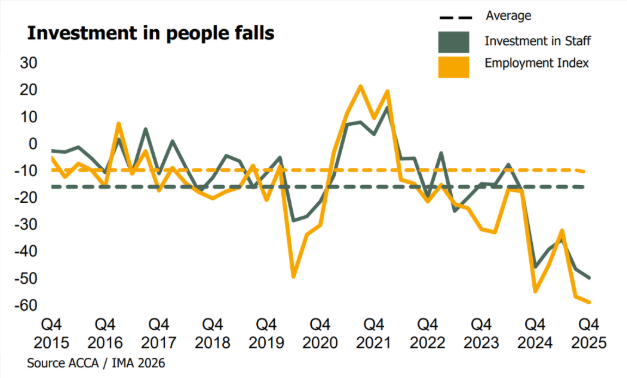
- The government may wish to consider how investment in talent can ensure there is adequate talent available for growth companies and how that talent can be retained in those companies. ACCA would suggest EMI together with other talent measures such as a skills tax credit be considered. We would be happy to support aligned measures, including trials, to assess impact. As reported in ACCAs Global Economics Conditions Survey (GECs) UK SMEs Q4 2025 results, the employment index “demonstrated heightened caution among smaller firms” and is “at a record low”. “The continuing decline in our employment and investment in people indices is concerning”.
To read our comments in full, please download the document found on this page.
