

Taxation of capital gains in Malaysia
As at 31 March 2026
This article serves as reference material for candidates preparing for the ATX-MYS exam from the December 2026 session onwards. The laws referred to are those in force at 31 March 2026. This article is based on current legislation and does not focus on subject matters (such as case law, financial services, insurance, Islamic financing, property development, and construction) which are not included in the ATX Malaysia syllabus.
The abbreviations used in this article are:
- CGT - Capital gains tax
- CI - Chargeable Income
- DGIR - Director General of Inland Revenue
- EPF - Employees’ Provident Fund
- FSI - Foreign-Sourced Income
- IRB - Inland Revenue Board
- LLP - Limited Liability Partnership
- NR - Non-resident
- RPGT - Real Property Gains Tax
- Section - S. or s.
- USCIM - Unlisted Shares in a Company Incorporated in Malaysia
- w.e.f. - with effect from
- YA - Year of Assessment
Any reference to a section or schedule in this article refers to a provision of the Income Tax Act 1967 (the Act), unless otherwise specified.
This article is organized as follows:
A. Background
B. Introduction of s.4(aa)
C. CGT
D. Capital assets situated in Malaysia
E. Disposal
F. Shares
G. Exemptions
H. Losses
I. Rates of tax on capital gains
J. Compliance requirements
A. Background
Until Oct 1975, capital gains were not subject to tax in Malaysia.
With the promulgation of the Real property Gains Tax (RPGT) Act 1976, capital gains from the disposal of real properties situated in Malaysia began to be subject to RPGT. The primary objective was to curb widespread speculations in the property market and to curb rising property prices to levels beyond the reach of ordinary citizens in Malaysia.
In Oct 1988, the RPGT Act 1976 was amended to impose RPGT on the gains from the disposal of shares in a land-rich company, called a real property company (RPC). This plugged a loophole whereby an RPC was used as the holding vehicle, and the subsequent disposal of RPC shares had avoided RPGT.
B. Introduction of section 4(aa): gains and profits from the disposal of capital asset
With effect from (w.e.f.) 1 January 2024, a new section 4(aa)[s.4(aa)] was introduced into the Income Tax Act 1967 (the Act). This effectively treats the gains and profits from the disposal of capital asset as ‘income’ under the Act, despite the fact that they represent gains of capital nature. Thus, without having to introduce a new tax act, capital gains became subject to tax under the existing Income Tax Act.
For ease of reference, the term capital gains tax (CGT) is used in this article to refer to the aforementioned gains taxable under s.4(aa).
C. CGT
The scope
CGT is imposed on the gains or profits from the disposal of a capital asset in a year of assessment (YA) as income under s.4(aa).
‘Capital asset’ is defined in s.2 to mean:
(a) movable or immovable property situated outside Malaysia including any rights or interests thereof, or
(b) movable property situated in Malaysia which is a share of a company incorporated in Malaysia not listed on the stock exchange (including any rights or interests thereof) owned by a company, limited liability partnership, trust body or a co-operative society (CLTC).
Bearing in mind the exemption of all non-resident persons on ‘income arising from sources outside Malaysia received in Malaysia’ [under paragraph 28, Schedule 6] of the Act, the above definition of ‘capital asset’ means that gains or profits from the disposal of
(a) all movable and immovable assets situated outside Malaysia by all resident persons are subject to income tax in Malaysia when such gains are received in Malaysia pursuant to the remittance scope of charge in s.3 of the Act; and
(b) only movable property in the form of shares in an unlisted company incorporated in Malaysia (including a Labuan entity) held by a CLTC
are subject to tax under s.4(aa).
Significantly, it means that resident individuals are out of scope under (b) above. [More discussion about this under item D(2).]
S.4(aa) is also specifically excluded from being classified as a business source. This has implications on the eligibility for capital allowances and losses.
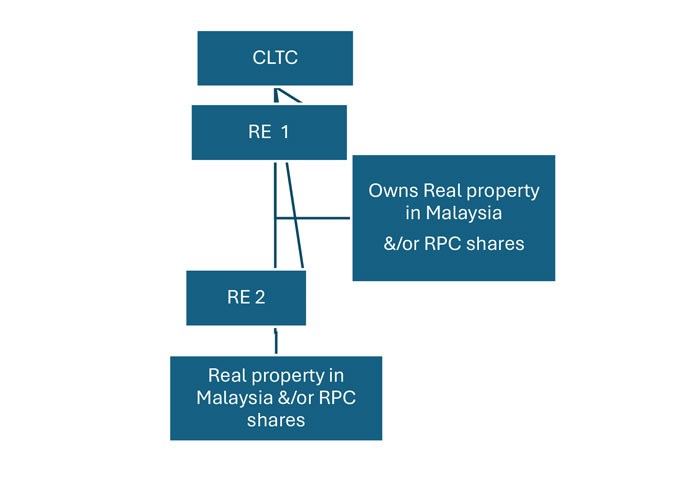
Additionally, a new s.15C was introduced w.e.f. 1 January 2024 to deem as derived from Malaysia gains and profits accruing to a CLTC on the disposal of a capital asset which is a share of a controlled company incorporated outside Malaysia [relevant company (RE)] where the RE derives its value substantially (at least 75%) from holding real property situated in Malaysia or shares in an RPC.
Thus, the concept of RPC shares is incorporated in the Act.
D. Capital assets situated in Malaysia
1. CLTC: the four chargeable persons
The four chargeable persons owning and disposing of movable assets in the form of unlisted shares of a company incorporated (USCIM) in Malaysia are:
Company
This means a body corporate and includes any body of persons established with a separate legal identity by or under the laws of a territory outside Malaysia, and a business trust. Hence, foreign-incorporated companies and NR companies are included.
Limited liability partnership
This means an LLP registered under the LLP Act 2012 [Act 743]; LLPs registered outside Malaysia are excluded.
Trust body
In relation to a trust, means the trust body provided for under s.61, ie it includes unit trust, resident trust, NR trust, trust created in Malaysia or outside Malaysia, but excludes a Real Estate Investment Trust (REIT) or Property Trust Fund (PTF).
Co-operative society
This means a co-operative society registered under any written law relating to the registration of co-operative societies in Malaysia. Hence, co-operative societies registered outside Malaysia are excluded.
2. Individuals are out of scope for capital gains derived from Malaysia
Based on the definition of ‘capital asset’, only USCIM owned and disposed of by a CLTC is caught for CGT.
This means other persons, including resident individuals, are out of scope for CGT in respect of capital gains from the disposal of capital asset situated in Malaysia.
The upshot is while resident individuals are conceptually subject to CGT under s.4(aa) in respect of gains from the disposal of capital asset situated outside Malaysia, they are out of scope in respect of the disposal of a capital asset situated in Malaysia.
[Note: The foreign-sourced capital gain received by a resident individual is exempt by the order PU(A) 234/2022, as amended by PU(A) 451/2024, until 31 December 2036. Below is an extract:
Exemption
3. (1) The Minister exempts a qualifying individual from the payment of income tax in respect of the gross income from all sources of income under s.4 of the Act, excluding a source of income from a partnership business in Malaysia, which is received in Malaysia from outside Malaysia in the basis period for a YA.
E. Disposal
The term ‘disposal’ was originally defined in s.65C to mean
‘sell, convey, transfer, assign, settle or alienate whether by agreement or by force of law and to include a reduction of share capital and purchase by a company of its own shares’.
W.e.f. 1 January 2026, the meaning of ‘disposal’ was broadened to include (b) and (c) as follows:
(a) to sell, convey, transfer, assign, settle or alienate whether by an agreement or any written law
(b) an extinguishment of any rights due to the dissolution or winding up of a company, or
(c) a reduction of share capital, conversion of shares, redemption of shares, purchase by a company of its own shares or ownership of the capital asset ends.
The date of disposal is:
- the date of written agreement, or
- in the absence of a written agreement, the earlier of the date of transfer of ownership or the date when full consideration has been received.
IRB has confirmed [IRB Guidelines dated 27 March 2024 para 6.2] that only capital gains that arise from a disposal on or after 1 January 2024 are subject to tax under s.4(aa). Hence, capital gains received in Malaysia from outside Malaysia where the disposal of capital asset occurred before 1 January 2024 are NOT subject to tax in Malaysia.
F. Shares
1. Definition of ‘share’
As defined in s.2, ‘share’, in relation to a company, includes stock other than debenture stock. IRB guidelines explained shares as having ‘equity’ features such as ordinary shares, preference shares, redeemable shares, convertible bonds or long-term borrowing with equity features. Examples of equity features are:
- Shareholder’s right to receive dividend is not fixed
- Shareholder’s right to residuary assets of the company ranks after other claimants in a liquidation
- The shares have no maturity date
- The shares carry voting rights.
2. RPC shares
The definition of ‘capital asset’ in the Income Tax Act 1967 includes USCIM. This renders the gains on the disposal of USCIM by a CLTC conceptually subject to income tax.
Such gains should therefore be outside the realm of gains under the RPGT Act as ‘gains’ therein means:
(a) gain other than gain or profit chargeable with or exempted from income tax under the income tax law, or
(b) in the case of a unit trust, gain not treated as income under the income tax law;
The RPGT Act [paragraph 34A, Schedule 2] was accordingly amended w.e.f. 1 January 2024 by inserting a new sub-paragraph (5A) to exclude the imposition of RPGT on the disposal of RPC shares by a CLTC (other than a Labuan entity).
With this, the way is clear for CGT to be applicable for the disposal of RPC shares by a CLTC under s.4(aa) of the Income Tax Act, and not under RPGT Act.
It should be noted that RPGT Act nevertheless continues to apply to a CLTC in respect of disposal of chargeable assets other than RPC shares.
G. Exemptions
Some exemptions from CGT have since been legislated.
1. Period 1 January 2024 – 29 Feb 2024
The initial public announcement stated ‘1 January 2024’ as the commencement date for CGT. However, it soon transpired that the actual date of commencement was intended to be 1 March 2024: the PU(A) 410/2023 duly provided the legislative basis for the 1 March 2024 commencement date.
Under this order, CLTCs are exempted from CGT [PU(A) 57/2024] in respect of capital gains arising from disposal of capital assets from 1 January 2024 to 29 February 2024. Below are extracts from the order:
Exemption
(1) The Minister exempts a CLTC from the payment of income tax in respect of any gains or profits received from the disposal of shares under s.15C of the Act.
(2) The disposal of shares referred to in subparagraph (1) shall be made on or after 1 January 2024 to 29 February 2024.
Non-application
This Order shall not apply to a disposal of shares referred to in subparagraph 2(1) where gains or profits from the disposal of shares is chargeable to tax as a business income under paragraph 4(a) of the Act.
2. CLTC is exempt from foreign-sourced capital gains until 2030
Presumably to afford CLTC some breathing space or preparatory time, an exemption from CGT is provided for the period of 1 January 2024 to 31 December 2030. [Note: The exemption order PU(A) 75/2024 initially had effect from 1 January 2024 to 31 December 2026. This was further extended to 31 December 2030.]
Extracts from the abovementioned exemption order are reproduced below to provide a comprehensive picture of the exemption, including the conditions, exclusions, etc:
Exemption
2. (1) Subject to paragraph 3, the Minister exempts a CLTC resident in Malaysia from the payment of income tax in respect of gains or profits from the disposal of capital asset arising from outside Malaysia which is received in Malaysia in the basis period for a YA.
(2) For the purposes of exemption under subparagraph (1), the CLTC shall, in the basis period of a YA, comply with the conditions imposed by the Minister as specified in the guidelines issued by the DG under s.134A of the Act, which shall include the following conditions:
(a) employ an adequate number of employees in Malaysia, and
(b) incur an adequate amount of operating expenditures in Malaysia.
(3) Any deduction in relation to the income exempted under this paragraph
shall be disregarded for the purpose of ascertaining the CI of the CLTC.
Gains or profits from disposal of intellectual property rights
3. (1) Any gains or profits from the disposal of intellectual property (IP) rights
shall be disregarded for the purpose of ascertaining the gains or profits from the disposal of capital asset referred to in subparagraph 2(1) provided that the CLTC is the owner or licensee of the intellectual property rights.
(2) In this paragraph, ‘IP rights’ means any rights arising from a patent, utility innovation and discovery, copyright, trade mark and service mark, industrial design, layout-design of integrated circuit, secret processes or formulae and know-how, geographical indication and the grant of protection of a plant variety, or other similar rights, whether or not registered or registrable.
Non-application
4. This Order shall not apply to a person carrying on the business of banking, insurance, sea transport or air transport.
3. Restructuring of companies scheme
Another exemption pertains to the disposal of shares in preparation for a restructuring scheme. The exemption order PU(A) 289/2024 is effective for the period of 1 March 2024 to 31 December 2028.
Extracts from the order are reproduced below for a comprehensive picture:
2. (1) The Minister exempts a CLTC from the payment of income tax in respect of CI from gains or profits received from the disposal of USCIM to an acquirer company, a company resident in Malaysia.
(2) For the purposes of exemption under subparagraph (1):
(a) the disposal of shares shall be made within the period from 1 March 2024 to 31 December 2028
(b) the shares shall be disposed of under a scheme for restructuring of companies in the same group to increase efficiency in the operation of the CLTC, or the acquirer company or both, and
(c) the consideration for the disposal of shares shall consist of shares in the acquirer company or not less than 75% of shares in the acquirer company and the balance of a money payment, and the shares shall be issued to the CLTC.
(3) Subject to subparagraph (4), the CLTC shall apply in writing to the DGIR after the period of 3 years from the date of the disposal of shares by the CLTC.
(4) The CLTC shall comply with the conditions imposed by the Minister as specified in the guidelines issued by the DGIR under s.134A of the Act.
Loss from disposal of shares
3. Where the CLTC incurs any loss from the disposal of shares referred to in paragraph 2 within the period from 1 March 2024 to 31 December 2028, such loss shall be disregarded for the purposes of subsections 65E(5) and (6) of the Act.
Determination of acquisition amount or value of consideration for subsequent disposal of shares
4. If the acquirer company subsequently disposes of the shares referred to in para.2, the acquisition amount or value of consideration determined for the shares shall be deemed to be equal to the amount or value of consideration determined under para. 65E(2)(b) of the Act paid for the shares by the CLTC plus the allowable expenses under subparagraphs 65E(2)(a)(i) and (ii) of the Act incurred by the CLTC.
Non-application
5. This Order shall not apply to:
(a) a disposal of unlisted shares of a company incorporated in Malaysia where gains or profits from the disposal of shares is chargeable to tax as a business income under para. 4(a) of the Act;
(b) a disposal of shares by the CLTC in respect of restructuring of any companies for the purposes of an IPO and the application for the IPO has been made to the Securities Commission or Bursa Malaysia Securities Berhad; or
(c) a CLTC to which a tax exemption has been granted under para 127(3)(b) or subsection 127(3A) of the Act in respect of the same disposal of shares.
4. Initial Public Offering (IPO) shares
Disposal of shares in relation to the restructuring of any company for IPO is also exempt vide the order PU(A) 290/2024 during the period 1 March 2024 to 31 December 2028. Relevant extracts are as below:
(a) the disposal of shares by the CLTC shall be made within the period from 1 March 2024 to 31 December 2028
(b) the shares shall be disposed of in relation to restructuring of any company for an IPO
(c) CLTC shall apply for the IPO under the Capital Market and Services Act 2007 [Act 671] within the period of one year from the date of the disposal of shares:
(i) to the Securities Commission for the purpose of listing on the Main Market, or
(ii) to Bursa Malaysia Securities Berhad for the purpose of listing on the ACE Market and LEAP Market, and
(d) the CLTC shall obtain the approval for the application of the IPO referred to in subsubparagraph (2)(c) on or before 31 December 2028.
3. The CLTC shall apply in writing to the DGIR within the period of one year from the date of approval for the application of the IPO referred to in subsubparagraph (2)(c).
Loss from disposal of shares
4. Where the CLTC incurs any loss from the disposal of shares within the period from 1 March 2024 to 31 December 2028, such loss shall be disregarded for the purposes of subsections 65E(5) and (6) of the Act.
Non-application
5. This Order shall not apply to:
(a) a disposal of shares of a company incorporated in Malaysia which is not listed on the stock exchange where gains or profits from the disposal of shares is chargeable to tax as a business income under paragraph 4(a) of the Act
(b) a CLTC who has made an application for exemption under the Income Tax (Restructuring of Companies Scheme) (Exemption) Order 2024 [P.U. (A) 289/2024] in respect of the same disposal of shares, or
(c) a CLTC which a tax exemption has been granted under paragraph 127(3)(b) or subsection 127(3A) of the Act in respect of the same disposal of shares.
5. Unit trusts
Exemption order PU(A) 249/2024 provides Tax Exemption on Unit Trust’s Gains from disposal of shares. Extracts from the order provide further details:
1. Tax exemption on any gains/profits of a qualifying unit trust (QUT) resident in Malaysia received from the disposal of:
- Unlisted shares of a company incorporated in Malaysia, and
- Shares under s.15C of the Income Tax Act (ITA) 1967.
2. The disposal of the shares shall be made from 1 January 2024 to 31 December 2028.
3. The QUT shall not include a unit trust which is approved by the Securities Commission (SC) as a Real Estate Investment Trust (REIT) or Property Trust Fund (PTF) listed on Bursa Malaysia.
4. Any loss from the disposal of shares shall be allowed as a deduction in accordance with s.65E(5) and (6) of the ITA 1967 in ascertaining the chargeable income exempted.
5. The tax exemption shall not apply to any gains/profits from the disposal of shares chargeable to tax as a business income under s.4(a) of the ITA 1967.
H. Losses
Capital losses are allowed but quarantined, ie the loss arising from the disposal of capital assets may only be used to set off against the gains from the disposal of other capital assets. Any unabsorbed capital loss may be carried forward for up to ten YAs to be utilized against gains from disposal of capital assets in future. Any capital loss remaining un-utilised after the ten YAs will be disregarded.
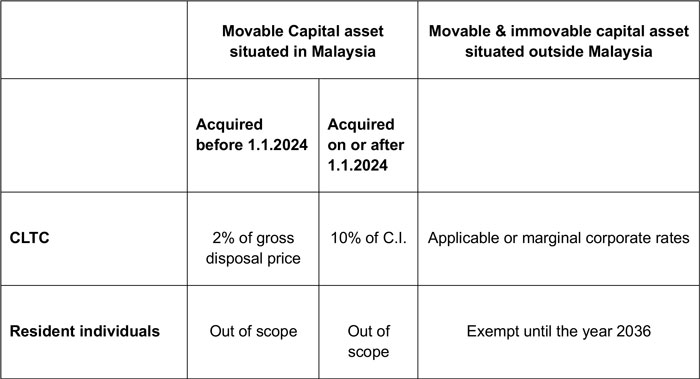
I. Rates of tax on capital gains: 2% or 10%
Income tax shall be charged for a YA on the income of a CLTC from the disposal of capital asset referred to in s.4(aa) at the following rates:
(a) in relation to a disposal of capital asset situated in Malaysia which was acquired before 1 January 2024:
(i) at the rate of 10% on every ringgit of the CI from the disposal of the capital asset, or
(ii) at the rate of 2% of the gross disposal price of the capital asset;
(b) in relation to a disposal of capital asset situated in Malaysia which was acquired on or after 1 January 2024 at the rate of 10% on every ringgit of the chargeable income from the disposal of the capital asset;
(c) in relation to a disposal of capital asset other than a disposal under paras (a) and (b) ie capital asset situated outside Malaysia, at the applicable rate to the CLTC as specified under Part I or IV on every ringgit of the CI from the disposal of the capital asset.
The rates for CLTC and resident individuals are summarised as below:
J. Compliance requirements
The gains from the disposal of capital asset situated in Malaysia ie USCIM by a CLTC shall be ascertained by reference to each disposal separately, and treated as a separate source of gains or profits from the disposal of capital asset. A separate return in a prescribed form must be furnished electronically for each disposal within 60 days from the date of disposal. The CGT is to be paid within 60 days from the date of disposal.
Foreign-sourced capital gains are subject to tax in the YA of receipt in Malaysia. Such gains are to be reported in the relevant annual tax return and be subject to tax at the applicable rate to the CLTC.
Records relating to the disposal should be retained for seven years.
Conclusion
The introduction of CGT under the Income Tax Act w.e.f. 1 January 2024 represents a major development in the Malaysian tax landscape. The Malaysian tax authorities have limited the scope at the start presumably to facilitate a smooth administration of the new tax measure. Further development and refinements are expected in the coming months and years.
Written by a member of the ATX-MYS examining team
