

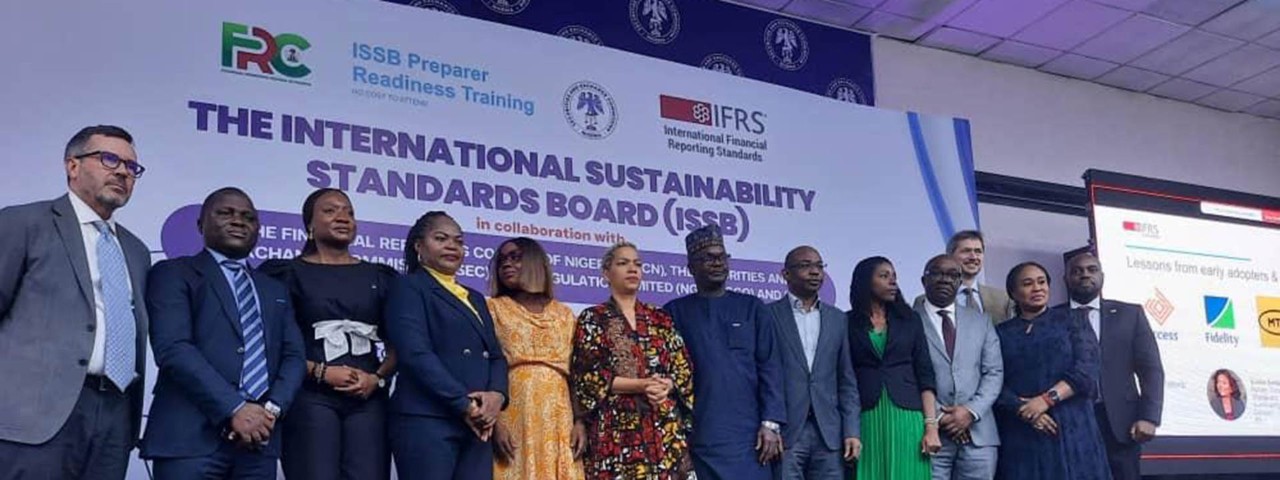
ACCA is supporting Nigeria’s Financial Reporting Council as the country becomes the first in Africa to adopt ISSB standards.
Partnering to drive forward progress
ACCA aims to drive sustainable business by promoting policies, regulations and standards that deliver prosperous, ethical, sustainable organisations and economies. As part of this, our chief executive, Helen Brand OBE, and the FRCN’s executive secretary, Rabiu Olowo, signed an agreement in February 2024 to collaborate on the adoption of sustainability standards and business practices in Nigeria.
Nigeria’s adoption approach
As the first African country to adopt the standards established by the International Sustainability Standards Board (ISSB), Nigeria’s adoption roadmap, released in March 2024, promised a phased approach to implementation.
Implementation in Nigeria is unfolding in four stages, with mandatory requirements coming into force from 2028, to allow time for entities to prepare for transition. The four early sustainability reporting adopters of 2024 have now swelled to more than 30 in the voluntary phase.
As part of our collaboration with FRCN, ACCA provided comments on the Nigeria Roadmap report on ISSB adoption, covering issues relating to the framework for Nigerian entities, the readiness test to ascertain the preparedness to adopt the IFRS sustainability disclosure standards, and key considerations for adoption such as materiality, governance, strategy, risk management and assurance.
We subsequently provided comments on the amended roadmap guidance, focusing on issues such as consistency of FRCN’s definition of interoperability with the ISSB, obscuring sustainability information, readiness assessment test, internal carbon price and reporting timelines.
Our response drew on findings from the Sustainability Working Group Africa, a collaboration of professional bodies and regulators of which we are a founding member.
FRCN then convened stakeholders to examine consolidated submissions for further policy integration into the roadmap. Our Africa public affairs team contributed to deliberations, ensuring that our contribution was integrated into the fabric of the roadmap. The regulator formally recognised the expert contributions and our role across the implementation cycle.
How we’ve helped
Nigeria’s adoption and implementation of the IFRS sustainability standards has followed a structured policy process, with ACCA actively engaged at each key stage.
During the early adoption phase, ACCA partnered with the FRCN under the SWGA initiative to produce practical insights on implementation challenges faced by reporting entities in the oil and gas, telecommunications, and banking sectors. The report highlighted key gaps and recommendations, which informed stakeholder engagement discussions and advocacy efforts.
This does not mark the end of our collaboration with the FRCN. We look forward to supporting readiness for the mandatory reporting phase, including for the public sector.
Lessons and opportunities from the Nigerian story
Nigeria’s approach to adopting the IFRS Sustainability Disclosure Standards provides important lessons for other emerging markets. One key lesson is that a sudden mandatory transition may create more implementation challenges than benefits. A phased and well-structured adoption approach, like Nigeria’s model, is therefore more practical and effective.
In addition, one of the major barriers to successful adoption is the shortage of technical expertise required to properly implement the standards. This highlights the importance of sustained capacity-building programmes and strategic partnerships. Such initiatives not only strengthen the capabilities of regulators but also provide essential training and learning opportunities for reporting entities and other adopters.
Furthermore, strong collaboration among regulators, professional bodies, businesses, and other stakeholders can play a significant role in addressing initial implementation concerns and supporting a smoother transition process.
Nigeria’s experience also demonstrates that while supporting the global ISSB baseline, regulators and stakeholders must recognise the importance of providing guidance that reflects local economic conditions and development priorities. To achieve the full benefits of the standards, they need to be implemented with proper consideration for the local context.
We also see that adopting sustainability standards can deliver significant strategic benefits for organisations by enhancing transparency, strengthening stakeholder confidence, increasing attractiveness to global institutional investors, and potentially reducing the cost of capital.
Implementing the standards is not a box-ticking endeavour. Organisations would need professionals who understand sustainability strategy, integrated decision-making, measurable ESG outcomes and transparent governance structures. This would mean that accountants and other professionals would be expected to help embed sustainability into business strategy rather than simply producing reports.
Also, Nigeria’s roadmap for adopting sustainability standards includes a phased assurance approach, moving gradually from limited assurance to reasonable assurance over time. This is expected to increase demand for professionals with expertise in areas such as sustainability assurance, internal controls over ESG data, climate-related risk verification, and governance and reporting systems. As a result, the transition is creating new career opportunities for accountants and auditors, while also expanding the role of finance professionals in sustainability reporting and assurance.