

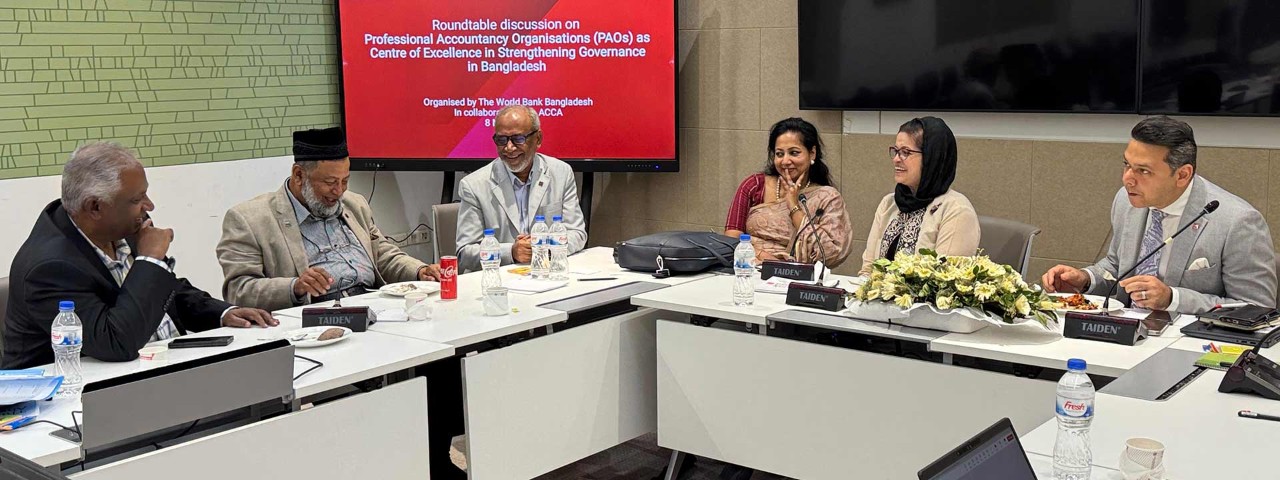
ACCA’s work in Bangladesh to strengthen governance and address skills gaps included a roundtable with the World Bank and FRC Bangladesh.
Bringing key organisations together
A high-level roundtable jointly organised by ACCA Bangladesh, the Financial Reporting Council (FRC Bangladesh and the World Bank focused on national governance reforms, aligning with key areas of ACCA’s policy work on bridging the skills gap and championing professional accountants.
Held in May 2025 at the World Bank office in Dhaka, the session titled ‘Professional Accountancy Organisations (PAOs) as Centres of Excellence in Strengthening Governance in Bangladesh’ brought together 30 participants from 17 organisations, including regulators, professional accountancy organisations (PAOs), academic institutions, development partners and private sector leaders.
The session was chaired by Suraiya Zannath, lead financial management specialist at the World Bank. The chief guest was Md Sajjad Hossain Bhuiyan, chair of the Financial Reporting Council (FRC). The discussion was facilitated by Pulkit Abrol, managing director of ACCA Asia Pacific.
Opening the discussion with a thought-provoking question - ‘If you could fix one governance challenge overnight, what would it be?’ - session moderator Pulkit Abrol encouraged participants to reflect on the key governance challenges facing Bangladesh and the role the accountancy profession can play in addressing them.
While the roundtable focused on Bangladesh’s governance landscape, the discussion strongly reflected ACCA’s global policy agenda. Participants consistently highlighted the importance of professional accountants in strengthening transparency, improving financial reporting and supporting sustainable economic development.
Why does governance matter now?
Bangladesh's economy has expanded rapidly over the past decade, supported by a dynamic private sector and growing financial markets. However, the demand for skilled financial professionals significantly exceeds the current supply.
Participants highlighted a significant imbalance in the profession:
- Bangladesh has over 300,000 registered companies and around eight million SMEs
- Yet the country has fewer than 4,000 fully qualified professional accountants
- Around 35,000 individuals are currently part-qualified
This gap creates challenges for maintaining strong financial reporting standards, corporate governance and regulatory oversight across the economy.
Professional accountancy organisations therefore play a critical role in developing professional capacity, upholding ethical standards and strengthening financial governance across both the public and private sectors.
Championing professional accountants in governance reform
A central theme of the roundtable was the growing importance of professional accountants in safeguarding governance and financial integrity in rapidly developing economies.
Bangladesh’s economic expansion has increased demand for reliable financial reporting, effective corporate governance and accountable public financial management. In this context, participants emphasised that professional accountants are essential to strengthening institutional trust.
Accountants contribute not only through technical expertise but also through their commitment to ethical standards and public interest responsibilities. By supporting transparent financial reporting, risk management and internal controls, they help organisations maintain accountability to regulators, investors and the wider public.
Participants also emphasised that accountants should increasingly be recognised as strategic advisers, rather than solely compliance professionals. Their insights can support better organisational decision-making, strengthen governance frameworks and contribute to long-term business sustainability.
The engagement was highly aligned with ACCA’s global policy call-to-action on championing the role of professional accountants, and reinforcing the profession’s role as a driver of responsible business practices and economic resilience.
Bridging the skills gap for sustainable business
The roundtable highlighted a major structural challenge facing Bangladesh’s financial ecosystem: the shortage of qualified professional accountants.
Despite the country’s rapidly expanding business environment, the limited pool of qualified professionals creates risks for governance, financial reporting quality and regulatory oversight. Without sufficient professional expertise, organisations may struggle to maintain robust financial controls and compliance standards.
Professional accountancy organisations therefore play a crucial role in expanding access to professional education, strengthening technical training and maintaining internationally recognised standards of competence and ethics.
These discussions strongly align with ACCA’s policy call-to-action on bridging the skills gap and to drive sustainable business, highlighting how investment in professional education contributes directly to stronger economic institutions.
Strengthening regulatory collaboration
Another important outcome of the roundtable was the emphasis on stronger collaboration between regulators and professional bodies.
Participants highlighted the potential for deeper engagement between FRC and professional accountancy organisations (PAOs) to strengthen Bangladesh’s governance ecosystem.
A collaborative model was discussed in which:
- FRC focuses on regulatory oversight and enforcement, while
- PAOs support professional training, standards implementation and capacity building
Such cooperation can help ensure regulatory frameworks are both practical and effective while supporting consistent implementation of financial reporting and governance standards across the economy.
This collaborative approach reflects ACCA’s wider policy strategy of working with regulators, governments and international institutions to promote strong governance and financial transparency.
From dialogue to action
As a next step, ACCA is developing ‘Theory of change’ concept notes in collaboration with FRC, The Institute of Chartered Accountants of Bangladesh (ICAB) and Institute of Cost and Management Accountants (ICMAB). These will help position PAOs as centres of excellence for governance reform in Bangladesh.