

Part 1: Finance Act of 2025 and other laws as at 31 March 2026
Relevant to those sitting ATX-MYS in December 2026, March 2027 and June 2027
Introduction
This is the first of two articles, provided by the ATX-MYS examining team to update candidates on the legislation and related resources pertaining to advanced taxation in Malaysia, covering areas of direct and indirect taxes, which are included in the ATX-MYS syllabus.
These articles should be read by candidates who are preparing for the ATX-MYS exam in the period from 1 December 2026 to 30 June 2027.
This Part 1 provides an overview of the main features of the Malaysian tax system covered in the ATX-MYS syllabus as at 31 March 2026, commencing with a summary of the contents of this article.
Part 2 considers the changes brought about by:
- Finance Act 2025, Act 874, gazetted on 31 December 2025
- Measures for the Collection, Administration and Enforcement of Tax Act 2025, Act 875, gazetted on 31 December 2025, and
- Several gazette orders.
It should be noted that the subject matter of tax on gains or profits from the disposal of capital assets (capital gains), which was introduced in Act 851 and amended by the Income Tax (Amendment) Act 2024, is now included in the ATX-MYS syllabus for December 2026 and subsequent exams.
Any reference to a section or schedule in these two articles refers to a provision of the Income Tax Act 1967, unless otherwise specified.
The abbreviations used in this article are as follows:
- AA - Annual allowance
- BC - Balancing charge
- CA - Capital allowance
- CGT - Capital gains tax
- CLTC - Company, Limited liability partnership, trust body, co-operative society
- FSI - Foreign-sourced income
- IA - Initial allowance
- IRB - Inland Revenue Board
- IHC - Investment holding company
- LLP - Limited liability partnership
- NR - Non-resident
- R - Resident
- SAS - Self-assessment system
- S - Section
- SI - Statutory income
- W.e.f. - With effect from
- WHT - Withholding tax
- YA - Year of assessment
The Malaysian tax landscape
- Types of taxes
- Sources of tax laws
- Scope of charge
- Classification of income
- Basis of assessment
- Tax administration
- Tax residence
- Steps in computing chargeable income
1. Types of taxes

WHT is intrinsically income tax compulsorily withheld at source at prescribed rates by the payer, to be paid over timeously to the IRB, when paying or crediting payments (such as royalties, interests, service fees, contract payments, etc) to an NR, or sales commissions to an R individual being an agent, dealer or distributor. Penalties apply to a payer who fails to comply with WHT provisions.
CGT is not a separate tax in Malaysia: it is imposed under the Income Tax Act by deeming gains on disposal of capital assets as income under s.4(aa). Further details on CGT, including its scope, application, exemptions, tax rates, treatment of losses and key compliance requirements, are covered in a separate article published on the ACCA’s website.
Dividend tax is also a tax on income under the Income Tax Act. It is imposed on dividend income distributed by a resident company, listed or unlisted, received by an individual shareholder, R or NR, in excess of RM100,000 in a YA.
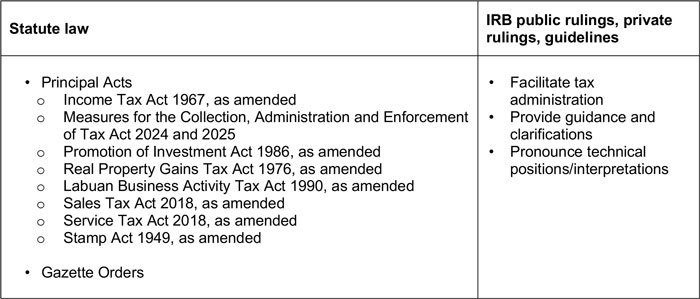
2. Sources of tax laws
3. Scope of charge
Malaysia adopts two out of the three scopes of charge of:
- derivation and remittance scope
- world scope
- territorial scope
Only derivation and remittance scope is included in the ATX-MYS syllabus, and this is considered further below.
Derivation and remittance scope
Residents
Generally, the income of any person (other than those under the world scope)
- accruing in or derived from Malaysia, or
- income received in Malaysia, from outside Malaysia,
is subject to tax in Malaysia.
Some exemptions of foreign-sourced income (FSI) for R persons have been introduced, subject to certain conditions, for the period of 1 January 2022 to 31 December 2036.
Non-residents
However, income arising from sources outside of Malaysia and received in Malaysia by any person who is NR in Malaysia is specifically exempt from income tax under paragraph 28 of Schedule 6.
4. Classification of income
Classes of income
Income subject to tax is classified as follows:
Section (s.) 4
(a) Business
(aa) Gains or profits on the disposal of capital assets (capital gains)
(b) Employment
(c) Dividends, interest or discounts
(d) Rents, royalties or premiums
(e) Pensions, annuities, or other periodical payments
(f) Other gains or profits not falling under (a) to (e)
s.4A Special classes of income for NRs including:
(i) income from services rendered by NRs for use of property/rights, or for installation/operation of any plant/machinery/apparatus purchased from such NRs*
(ii) income for any advice/assistance/services rendered in connection with any scientific, industrial or commercial undertaking, venture, project or scheme*
(iii) rent or other payments made for the use of any moveable property.*
* which is derived from Malaysia
s.4B Business income under s.4(a) shall not include:
- Interest (other than interest to a bank on debenture, mortgage)
- Capital gains under s.4(aa).
s.4C Gains or profits from stock-in-trade parted with under requisition of compulsory acquisition shall constitute business income.
Classification of income
It should be noted that sometimes an item of income may be capable of being classified under two classifications. For instance, rental income is normally classified as rent under s.4(d) if it remains a passive source of income from investment. However, if, in deriving rental income, elements of business income are exhibited, eg provision of active services relating to maintenance, utilities and security, the said rental income may be classified as business income under s.4(a).
The significance of classifying income in an assessment is that once an item of income is classified as business income, the attendant tax treatment, ie scope of deductions, eligibility for CA and carry forward of losses to be set off against future business income, etc., will automatically ensue.
It should also be noted that for any item to be classified under s.4(f), the amount must be income in nature and it must not be capable of being classified under any of the classifications of (a) to (e). Hence, capital gains cannot be properly classified as “other income”.
With effect from (w.e.f.) 1 January 2022, where any FSI is brought to tax in Malaysia, each item of FSI should be properly classified under the respective classes of income as business income, capital gains, dividend, interest etc. There are exemptions available for foreign-sourced dividend income through the relevant statutory rules. Generally, resident individuals and companies receiving foreign dividends, subject to certain criteria, are tax exempt in respect of the foreign-sourced dividend.
New source of income
W.e.f. 1 January 2024, a new source of income, section 4(aa), being gains and profits from the disposal of capital asset, was introduced. As noted earlier, the definition ‘capital assets’ are covered separately in the CGT article available on the ACCA’s website.
5. Basis of assessment
Main points
Below is a reminder of the main points regarding the basis of tax assessment:
- The YA coincides with the calendar year, ie 1 January to 31 December.
- The calendar year is the basis year.
- The basis period may be either one of the following:
- The financial year or accounting year for company, limited liability partnership, trust body or a co-operative society (CLTC), eg 1 July 2025 to 30 June 2026 is the basis period for YA 2026 for ABC Sdn Bhd.
- The basis year is the basis period for all other chargeable persons, ie individual, partnership, body of persons, etc.
- The basis period for a YA is the current year, eg YA 2026 is based on the basis period ending in the current year of 2026, eg year-ended 31 January 2026, year-ended 30 September 2026, year-ended 31 December 2026, etc.
- Malaysia operates a SAS for all persons subject to provisions under the Income Tax Act 1967, the Real property Gains Tax Act 1976, and the Stamp Act 1949.
- In relation to a CLTC, ‘operations’ means a business or making of investments. Hence, a company is said to have commenced operations when it commences its business activity, or when it makes an investment (such as placing a fixed deposit in a bank, gives a loan to its subsidiary, or acquires shares in a company) prior to commencing the business.
The significance of the date of commencement of a business activity lies in the time delineation of deductibility of expenses and the eligibility for CA.
- Malaysian companies are subject to the single-tier system, under which a resident company is not entitled to impute the tax paid by the company to its shareholder when paying or crediting a dividend. The single-tier dividend is specifically exempt from income tax in the hands of the shareholder who is not an individual. W.e.f. 1 January 2025, for an individual, resident and non-resident, dividend income of up to RM100,000 is tax exempt for each basis period.
Basis periods
The basis period needs to be determined when a CLTC:
- Commences operations and prepares accounts for a period
- Embarks on additional business activity, or
- Fails to prepare its accounts to the corresponding day and changes its accounting date.
S.21A of the Act is the legislative basis and the Public Rulings 8/2014, 7/2016, and 6/2021 provide guidance on the determination of the basis periods.
For a person other than a CLTC, s.21 and Public Ruling 4/2017 provide respectively the legislative basis and IRB guidance on the determination of basis periods for a business source.
6. Tax administration
The main aspects of tax administration are as follows:
- Tax returns
- Assessments
- Tax payments
- Time bar, error and mistake, and other reliefs
- Offences and penalties
- Appeals
Timely compliance with the relevant deadlines in respect of the above removes or reduces the exposure to penalties, thus relieving pressure on cash flow and preserving the reputation of the taxpayer. In particular, good management, in terms of timely and accurate tax estimates, ensures that optimal tax instalments are payable. This will avoid incurring a penalty for under-estimation, or tying up precious cash flow in overpaying.
7. Tax residence
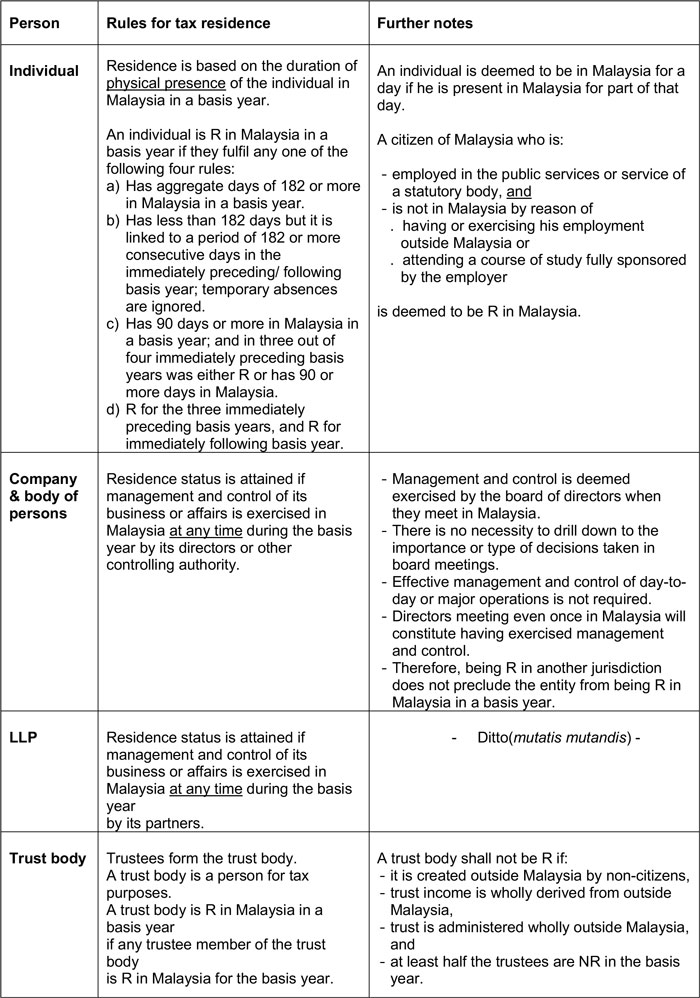
Significance of tax residence status:
| Personal reliefs | Only R individuals qualify for personal tax reliefs | |
| Tax rates | R individual is taxed at the scaled rates. NR individual is taxed at the fixed rate of 30%. |
|
| Tax exemptions | Certain tax exemptions are accorded to R only, while other exemptions are for NRs only. |
|
| Treaty protection/benefits | Only an R person is eligible for treaty benefits. | |
| Investment incentives | Generally, only Rs are eligible for tax incentives. | |
| Status of dividends distributed | Dividend distributed by a R company is deemed derived from Malaysia. |
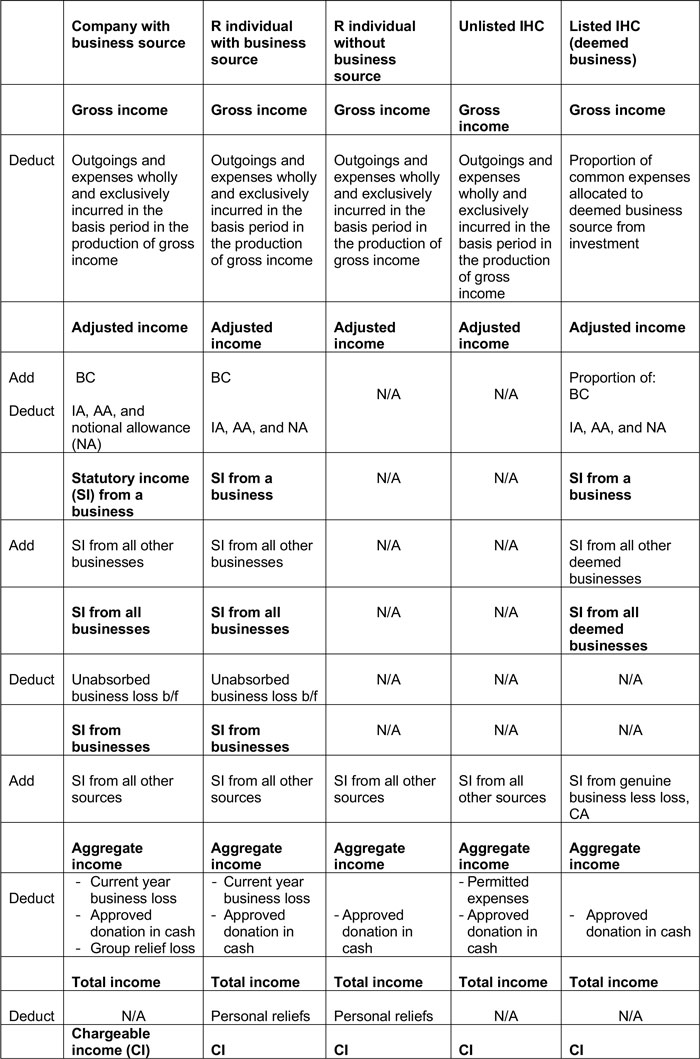
8. Steps in computing chargeable income
The Act provides for specific steps for the computation of chargeable income for a person. Below are the proforma computations for selected persons. Note that the computations involving tax incentives are not featured here.
Written by a member of the ATX-MYS examining team
