

IFRS 15 Revenue from Contracts with Customers – part 2
This is the second of two articles on the topic of IFRS 15 Revenue from Contracts with Customers.
IFRS 15 provides a five-step approach to revenue recognition, as follows:
| 1 - Identify the contract |
| 2 - Identify the separate performance obligations |
| 3 - Determine the transaction price |
| 4 - Allocate the transaction price to performance obligations |
| 5 - Recognise revenue |
The first article covered steps 1-3. This article will cover steps 4 and 5, as well as the accounting treatment of contract modifications and contract costs.
Step 4 – Allocate the transaction price to performance obligations
IFRS 15 states that an entity shall allocate the transaction price to each performance obligation identified in the contract in proportion to their stand-alone selling prices.
The stand-alone selling price of each performance obligation is defined by IFRS 15 as the price at which an entity would sell a promised good or service separately to a customer.
In many cases, this will be based on a standard ‘list’ price, or prices which have been charged to other customers when the goods or services have been sold individually. This would provide an ‘observable’ price.
If, however, there is no observable stand-alone price available, IFRS 15 requires the entity to estimate one. It mentions the following suitable methods:
1) Adjusted market assessment approach – using observable market prices for similar goods or services and adjusting
2) Expected cost plus margin, and
3) Residual approach – the total transaction price less the sum of observable stand-alone selling prices for the other performance obligations in the contract.
IFRS 15 states that a residual approach should only be used in limited circumstances, when the selling price is particularly uncertain. An example of this would be if the good or service has never been sold on a stand-alone basis.
A combination of methods may be used across the different performance obligations within a contract. The main aim is to ensure that an appropriate proportion of the transaction price is allocated to each performance obligation to reflect the amount of consideration expected to be received in exchange for satisfying each of the obligations.
EXAMPLE
The extract below is taken from Q3 of the published September/December 2024 sample exam.
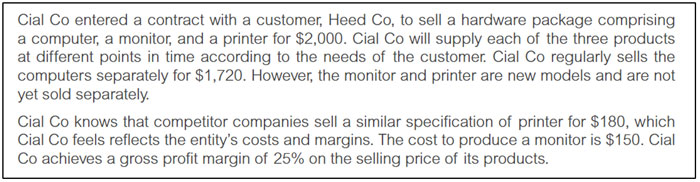
The requirement asked candidates to explain, with calculations, how the transaction price should be allocated to the hardware package sold to Heed Co.
We can see here that there is an observable stand-alone selling price for the computer of $1,720. However, stand-alone prices need to be estimated for both the monitor and printer.
We are given further information regarding both the printer and the monitor, and this enables us to estimate a stand-alone selling price for each.
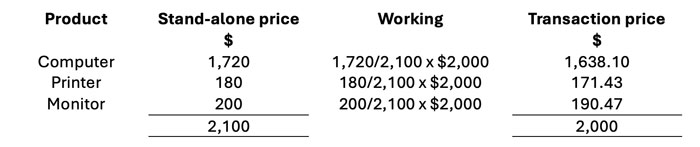
Starting with the printer, we are told that a competitor sells a similar printer for $180 and therefore this provides a reliable estimate of the stand-alone selling price. There is no need to make any adjustments as Cial Co feels that this price reflects its own costs and margins.
For the monitor, we can apply the expected cost plus margin approach to estimate a selling price of $200 ($150 x 100/75).
The final step is to allocate the total transaction price of $2,000 to the three performance obligations (distinct products) based on these standalone prices, as follows:
Step 5 – Recognise revenue
IFRS 15 states that an entity shall recognise revenue when (or as) the entity satisfies a performance obligation by transferring a promised good or service (ie an asset) to a customer. An asset is transferred when (or as) the customer obtains control of that asset.
Entities are required to determine whether revenue will be recognised over time, or at a point in time, at inception of the contract.
Revenue over time
Revenue will be recognised over time if one of three conditions, set out below, is satisfied.
Condition 1: the customer simultaneously receives and consumes the benefits provided by the entity’s performance as the entity performs
Service-related contracts will typically satisfy this condition. Think of a recurring payroll service: the customer will benefit from the performance of the payroll as it is processed and as its employees are paid each month.
Condition 2: the entity’s performance creates or enhances an asset which the customer controls as the asset is created or enhanced
An example of an asset being created would be the construction of a building on land already owned by the customer. If an extension was being added to an existing building, this would be an enhancement of an existing asset instead.
In these scenarios, the customer controls any work in progress. This means that the customer is obtaining the benefits of the goods or services that the entity is providing and, thus, the performance obligation is satisfied over time.
Condition 3: the entity’s performance does not create an asset with an alternative use to the entity, and the entity has an enforceable right to payment for performance completed to date
Key to this condition is the specificity to the customer. If the asset being created had an alternative use, it would be similar to most standard inventory items; it would therefore be inappropriate to recognise any revenue prior to the inventory being transferred to any one of the entity’s customers.
Contracts to create bespoke assets, such as highly specialised equipment or customer-specific professional reports and opinions, will typically satisfy this condition.
The requirement to have an enforceable right to payment for performance completed to date before revenue can be recognised over time ensures that revenue is only recognised if the seller is entitled to economic benefits for the work completed. Otherwise, if the contract was cancelled, the seller would be left with no consideration, and a customer-specific asset with little to no resale value.
Recognising revenue over time
If one of the three conditions above is satisfied, revenue is recognised over time. The amount of revenue recognised is determined by measuring progress towards satisfaction of the performance obligation. Appropriate methods for measuring progress include both output and input methods.
Output methods include measures based on certification of work completed to date, appraisals of results achieved or milestones reached, and number of units delivered.
Input methods include costs incurred, resources consumed or labour hours.
If the progress towards satisfaction of the performance obligation cannot reasonably be measured, IFRS 15 states that revenue should not be recognised over time.
If the outcome of the contract cannot be reasonably measured due to a specific circumstance (such as the contract being at an early stage), but the entity expects to recover the costs incurred, revenue is recognised to the extent of the costs incurred.
Revenue at a point in time
If none of the three conditions discussed above are satisfied, then revenue will be recognised at a point in time. This will be the point in time when the customer obtains control of the good being transferred.
Control is defined as the ability to direct the use of, and obtain substantially all of the remaining benefits from, the asset. The benefits of an asset relate to the cash inflows which it generates, or the cash outflows saved.
IFRS 15 provides the following indicators that control over an asset has passed from the seller to the customer:
a) The entity has a present right to payment for the asset
b) The customer has legal title to the asset
c) The entity has transferred physical possession of the asset
d) The customer has the significant risks and rewards of ownership of the asset, or
e) The customer has accepted the asset.
IFRS 15 states that there may be other indicators that control has transferred. Therefore, it is important to focus on the definition of control when forming any conclusions about whether control has transferred from the seller to the customer.
EXAMPLE
The extract below is taken from Q3 of the December 2023 sample exam.
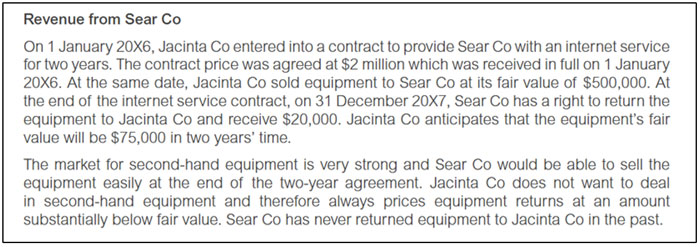
The requirement asked how revenue from the internet service contract and the sale of equipment should be accounted for in accordance with IFRS 15.
Starting with the internet service contract, the conclusion here is that Jacinta should recognise the revenue over time. Of the three conditions for recognition over time, it is the first one which is satisfied: the customer, Sear Co, simultaneously receives and consumes the benefits provided by Jacinta’s performance as Jacinta performs the service. There would be no need to mention the other two conditions – only one of them needs to be satisfied.
The $2 million should be recognised over the two-year term of the service, resulting in revenue being recognised in the current period of $1 million. The full $2 million has been received and so, on 31 December 20X6 (end of first year), there is a contract liability of $1 million.
Moving on to the sale of equipment, the key issue to discuss here is the right to return at the end of the two-year period. To answer this issue well, you should apply the basic principle of whether control has transferred to the customer.
Start with the definition:
Control is the ability to direct the use of, and obtain substantially all of the remaining benefits from, the asset.
Then discuss each element of the definition in relation to the scenario:
Sear Co will have the ability to direct the use of the equipment for at least two years, and this will be longer if the right to return is not exercised. Whether Sear Co has substantially all of the remaining benefits from the asset, however, will depend on whether the expectation is for the equipment to be returned or not.
Looking at the details provided, we can see that:
- $20,000 would be received upon return, but the equipment is expected to have a fair value of $75,000 and therefore $20,000 does not provide an incentive to return.
- There is a strong second-hand market, and Sear Co would easily be able to sell the equipment. This provides a further indication that Sear Co will not return the equipment, as it would make more financial sense to sell it instead and recover the fair value of $75,000.
- Jacinta does not deal in second-hand equipment and has purposely set the return price at a low level. Also, Sear Co has never returned equipment to Jacinta in the past. These are further indications that the equipment will not be returned.
This information suggests that the equipment will not be returned. Therefore, it can be concluded that control transferred to Sear Co on 1 January 20X6. Revenue of $500,000 should be recognised at this date.
Other revenue issues
Contract modifications
If a contract is modified, IFRS 15 states that an entity should account for it as a separate contract if both of the following conditions are present:
a) the scope of the contract increases because of the addition of promised goods or services which are distinct, and
b) the price of the contract increases by an amount which reflects the entity’s stand-alone selling prices of the additional promised goods or services (subject to appropriate adjustments to reflect the circumstances of the particular contract, such as discounts offered to the customer).
If a contract modification is not accounted for as a separate contract, there are two possible ways to account for the modification:
a) termination of existing contract and creation of new contract – if the remaining goods or services are distinct from the goods or services transferred before the modification, or
b) part of the existing contract – if the remaining goods or services are not distinct and, therefore, are part of the single performance obligation that is partly satisfied at the date of the modification.
The main impact of whether the modification is a separate contract or not is whether the additional consideration should be added to the existing contract, or whether it should be kept separate.
EXAMPLE
The extract below is taken from Q3 of the published March/June 2025 sample exam.
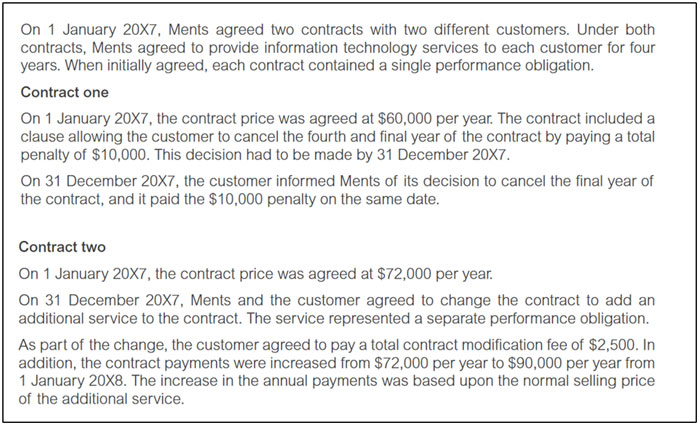
In contract 1, the modification does not result in the addition of distinct goods or services and so there is no separate contract to recognise.
Revenue of $60,000 will have been recognised in relation to the contract in the year ended 31 December 20X7.
Following the modification, the consideration to be received over the two remaining years is $130,000 (($60,000 x 2) + $10,000 penalty). Revenue of $65,000 ($130,000/2 years) will therefore be recognised in each of these two years.
In contract 2, an additional service is being added as a result of the modification, with the increase in price reflecting the normal (ie stand-alone) selling price for the additional service. The modification is therefore treated as a separate contract.
The revenue relating to the original contract will continue to be $72,000 each year for the remaining three years.
The total annual consideration receivable in relation to the new contract is $18,000 ($90,000 – $72,000). The modification fee of $2,500 should also be spread over the three-year term. The revenue to be recognised from the new contract each year is therefore $18,833 ($18,000 + ($2,500/3)).
Contract costs
IFRS 15 does not only provide principles about revenue recognition; it also covers the topic of contract costs.
The Accounting Standard outlines two types of contract costs:
1) Incremental costs of obtaining a contract; and
2) Costs to fulfil a contract, assuming they are not within the scope of another standard, such as IAS 2 Inventories or IAS 16 Property, Plant and Equipment.
IFRS 15 states than an entity recognises the incremental costs of obtaining a contract with a customer as an asset if the entity expects to recover those costs. The incremental costs of obtaining a contract are those the entity would not have incurred if the contract had not been obtained.
An entity recognises an asset from the costs incurred to fulfil a contract only if those costs meet all the following criteria:
- the costs relate directly to a contract the entity can specifically identify
- the costs generate or enhance resources of the entity which will be used to satisfy performance obligations in the future, and
- the costs are expected to be recovered.
If an asset is recognised in respect of contract costs, it is amortised to profit or loss as the related goods or services are transferred to the customer.
EXAMPLE
Rodri Co (Rodri) was one of three companies invited by a potential customer to a contract tender meeting. After the meeting, the customer informed Rodri that its tender had been successful and that it would be awarded the new contract.
In relation to the meeting, Rodri incurred the following costs:

The due diligence fees and the travel and accommodation costs would have been incurred regardless of whether the contract tender was successful. These costs are therefore recognised as an expense in the statement of profit or loss.
The sales commission of $5,000 is recognised as an asset because it is an incremental cost (ie it was only incurred because the contract tender was successful), and because it will be recovered through future contract revenue.
Conclusion
This two-part article has been written to help candidates understand the accounting principles relating to revenue, as well as some of the ways in which these principles might feature in the SBR exam. These articles are not exhaustive, and candidates should use them in preparation with their other study resources.
