

How to mitigate the most significant cyber threats facing UK accountancy firms

UK accountancy firms have long been one of the most attractive targets for cyber criminals.
From large audit practices to boutique firms and outsourced bookkeeping providers, firms operating in the sector regularly handle highly sensitive financial data, payroll information, tax records and confidential client details – making it a prime candidate for attack.
As threats evolve, so too must defences. Yet recent studies reveal persistent challenges: only 30% of leaders strongly agree that their firm’s data protection and compliance programmes are adequately supported by technology and investment, while just 29% believe their governance frameworks are robust enough to manage growing cyber risks effectively.
With over 70% of executives anticipating a rise in financial and data crime risks in 2025, the need for comprehensive cyber resilience across accountancy has never been clearer.
The most significant cyber threats facing UK accountancy firms can be grouped into six categories. Let’s explore these below.
1. Ransomware and data extortion
Ransomware has evolved from merely encrypting files to combining disruption, data theft and extortion. For accountancy firms – where access to client files, accounting systems and tax platforms is essential, even short periods of downtime can cause severe financial and reputational damage.
Attackers typically:
- gain access via phishing, exposed remote desktop services or third-party compromise
- deploy ransomware to lock critical systems and disrupt operations
- steal sensitive data such as client tax records, payroll information or audit files
- apply pressure through threats to publish stolen data or report breaches to regulators.
For practices managing confidential client data, this dual threat of operational paralysis and reputational harm makes ransomware one of the most feared attack vectors in the profession.
2. Business email compromise (BEC) and payment fraud
BEC remains one of the most profitable forms of cyber crime. Unlike malware, it relies on social engineering and trust manipulation – exploiting the authority and familiarity within client communications.
For accountancy firms, where payments, tax refunds and invoice processing are routine, a single fraudulent request can have devastating financial and reputational consequences.
Common tactics include:
- spoofing partners or directors to request urgent supplier or tax payments
- impersonating clients with ‘updated’ bank details
- hijacking genuine firm email accounts to intercept or alter invoices.
With many firms lacking formal payment verification protocols, BEC remains a leading cyber risk in the accounting sector.
3. Supply chain and third-party risks
Accountancy firms increasingly rely on cloud-based accounting platforms, outsourced IT providers, payroll systems and document management tools - each representing a potential point of failure.
Risks include:
- malicious code hidden in third-party software updates
- data breaches through outsourced bookkeeping or payroll providers
- weak integrations between cloud accounting systems exposing client information.
A single supplier compromise could cascade across multiple firms, damaging client trust and triggering regulatory consequences under data protection laws.
4. Insider threats and credential abuse
Insider threats, both deliberate and accidental, remain one of the most consistent risks within professional services. Malicious insiders might steal or sell client data, while well-meaning employees can fall victim to phishing and inadvertently expose credentials.
Key issues include:
- over-privileged access to client records or financial systems
- staff clicking on phishing links or using weak passwords
- contractors or outsourced accountants retaining system access after contracts end.
The potential impact is significant – one stolen administrator account could expose sensitive tax, payroll and audit data across hundreds of clients.
5. Phishing and social engineering
Phishing remains the most common entry point for cyber attacks on accountancy firms. Attackers increasingly target both employees and clients, crafting emails that appear to originate from legitimate accounting platforms or government agencies such as HMRC.
Tactics include fake login portals for cloud accounting tools, HMRC refund scams, or fraudulent tax deadline reminders.
With 80% of phishing campaigns now focused on credential theft, attackers can easily gain access to client data or internal systems – often using HTTPS to appear credible.
For firms bound by confidentiality and compliance obligations, the reputational impact of such breaches can be severe.
6. Emerging risks: AI-powered fraud and deepfakes
Artificial intelligence is transforming the cyber threat landscape. 61% of executives now cite AI-enabled fraud as a leading emerging risk.
AI is being used to:
- generate highly convincing phishing and invoice scams
- create deepfake audio messages of partners or clients authorising payments
- forge synthetic identities capable of passing AML or KYC checks.
Traditional verification and client authentication processes are being outpaced by these developments, requiring firms to invest in more advanced, AI-driven defences.
Building cyber resilience in the accountancy profession
Cybersecurity needs to be held in the same regard as any other core business function within accountancy firms. True resilience comes from integrating governance, technology and human awareness into every layer of practice management. In order to achieve a high level of cyber resilience and maturity, firms should consider the following:
- invest in layered defences: deploy firewalls, EDR and zero-trust frameworks aligned with business-critical systems
- adopt phishing-resistant authentication: enforce hardware security keys for partners, finance teams and payroll departments
- strengthen vendor governance: vet cloud accounting and IT providers, and include mandatory breach-notification clauses in contracts
- harden ransomware resilience: maintain secure, offline backups and implement privileged access management
- embed phishing awareness: provide continuous cyber awareness training for staff and partners
- ensure compliance readiness: develop a board-led breach response plan aligned with ICO and professional body expectations.
Creating a safer digital future for accountancy
The UK accountancy sector faces a complex and continually evolving cyber threat landscape – from ransomware and phishing to insider risks and AI-enabled fraud. Yet defences across the profession remain inconsistent, leaving many firms exposed.
By prioritising cyber resilience, strengthening governance, and investing in modern security technologies, accountancy firms can protect their clients, their reputation and the integrity of the profession as a whole.
PureCyber’s comprehensive service stack is designed to help financial institutions address these challenges head-on:
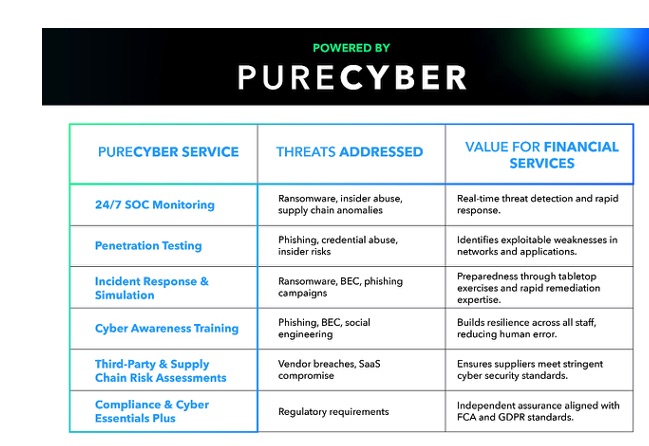
From 24/7 Security Operations Centre (SOC) monitoring to threat intelligence, penetration testing and supply chain risk management, our services provide the layered protection needed to stay ahead of cyber criminals. We also deliver compliance support and awareness training, ensuring your teams remain informed and resilient against emerging threats. In a sector reliant on trust and integrity, a strong cybersecurity posture is a foundational part of building that reputation.
The partnership between ACCA and PureCyber has been forged to support ACCA members and their businesses on their journey to improve their cyber resilience.