


Based on a global survey of 1,600 finance professionals, alongside qualitative insights from roundtables and interviews, the Enabling finance insight: Bridging skills and data gaps for AI-enabled finance report explores how finance leaders must seize this moment to shape their organisation's evolution.
Key findings
This report, published jointly by ACCA and Chartered Accountants Australia and New Zealand (CA ANZ), equips CFOs and finance leaders with actionable recommendations to architect a future where finance:
- Provides trusted insight
- Stewards data
- Governs AI responsibly
- Drives measurable value for the organisation.
Key messages overview
Strategic drivers are shifting how finance uses data
Finance’s data needs are being shaped by strategic priorities and regulatory compliance. This is accelerating the move toward real-time operational data and unstructured internal text data to support insight.
Need to champion data foundations for success
Effective use of advanced analytics and AI is hampered by:
- data quality problems
- analytical capabilities
- difficulty in integrating multiple data sources.
Distinguish AI for productivity and AI for value
AI is changing how finance performs descriptive, diagnostic, predictive and prescriptive work. This is improving productivity and freeing capacity for strategic activities. However, concerns about reliability, trustworthiness and explainability persist.
Steward data and AI to drive value
Finance’s cross-organisational visibility and governance expertise position it to lead responsible AI adoption. This includes:
- value definition
- FinOps
- data governance and stewardship
- AI governance to ensure ethical and compliant deployment.
Cultivate critical capabilities
A notable gap exists between the importance placed on future skills (particularly GenAI and predictive analytics) and current capability. Critical thinking, sceptical validation and contextual storytelling are essential to reduce automation bias, anchoring bias and deskilling risks.
Roles are evolving as data responsibilities expand
This research reveals what many finance professionals feel intuitively:
- finance is developing closer ties to technical teams
- the boundaries of finance are expanding. For finance new data and technology responsibilities are emerging.
Support risk mitigation through upskilling and collaboration
The dominant concern is not job displacement, but the verifiability and integrity of AI-generated insights. Formal upskilling and deeper collaboration with IT and data science functions are central risk controls and capability enhancers.
Barriers to data integration
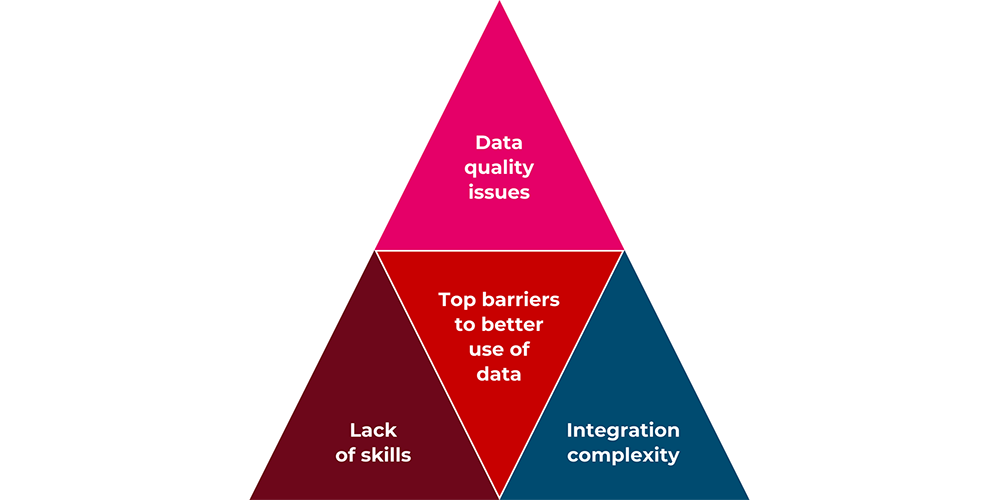
While the ambition to leverage real-time and unstructured data is clear – execution often stalls due to fundamental structural and capability gaps. Our data reveals a ‘triangle of frustration’ – where data quality issues (42%), lack of appropriate skills (42%), and difficulty integrating multiple sources (40%) form the primary barriers.
The triangle of frustration for data integration
Informal learning is insufficient
Too heavy reliance on self-directed, informal learning could be a strategic risk. Formal training programmes and dedicated budgets are needed to build consistent capability across the finance function.
Report examines following areas:
- The current state of data opportunities and challenges in finance teams
- AI is changing how finance delivers reporting and insight.
- How finance can support reasonable AI adoption and increased access to trusted insights.
- How finance can address skills gaps to meet new responsibilities and improve collaboration.
- How upskilling is also about risk mitigation.
Primary drivers of data evolution in finance
- Strategic priorities: 45%
- Regulatory requirements: 43%
- Cost optimisation: 37%
- Risk management: 35%
- More insight for internal stakeholders: 33%
- Technological advancements: 32%
- Customer expectations: 20%
- Competitive pressures: 18%
Conclusions
The finance function is at the forefront of a profound transformation, driven by the exponential growth of data and the disruptive power of AI. This is not merely a technological shift, but a fundamental evolution in how finance creates value, manages risk and provides strategic leadership.
To thrive in this evolving landscape and truly enable the future of insight, CFOs and finance leaders must embrace a proactive, architectural role. This involves strategic investments, intentional capability development, and a steadfast commitment to governance and critical judgment.
Recommendations
- Invest in data foundations as the bedrock for AI.
- Champion AI governance and measure tangible ROI.
- Proactively develop critical capabilities for finance evolution.
- Foster collaborative ecosystems and shift finance's role.
By embracing these recommendations, CFOs and finance leaders can steer their organisations through the current transformation, ensuring finance not only maintains its relevance, but fundamentally enhances its strategic contribution in the age of AI and abundant data. This is the essence of Finance Evolution: building a future where finance is not just an observer of change, but its architect.